Over the past 20 years, the achievements gained in the field of water security and water resources management in Azerbaijan have constituted one of the main directions of the country’s strategic development. President Ilham Aliyev’s speech at the meeting dedicated to the State Program for 2026–2035 on improving water supply, rainwater, and wastewater systems in Baku city and the Absheron Peninsula, held on January 12, clearly reflects the successes achieved in this field and future plans.
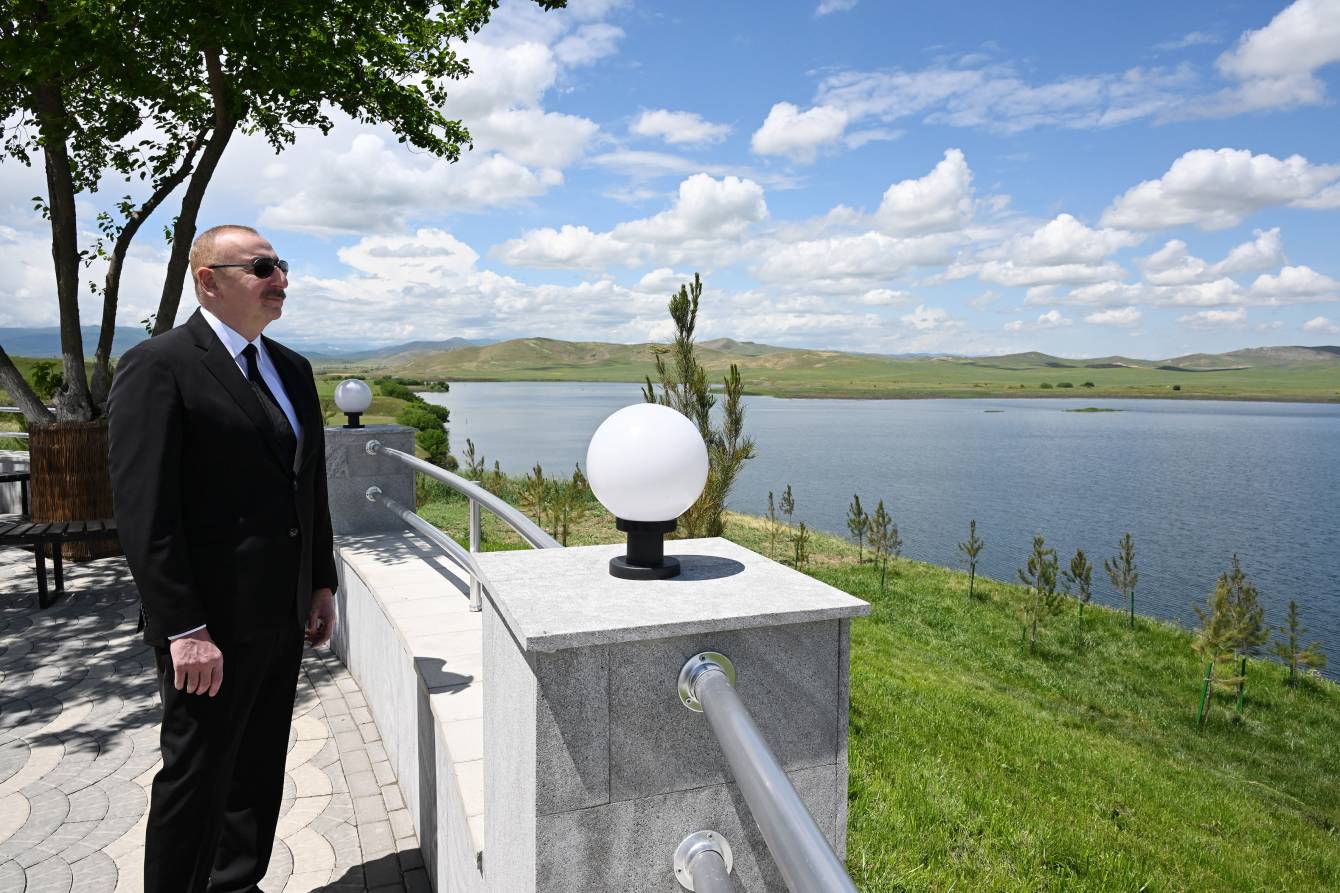
In his speech, President Ilham Aliyev stated: “Over the past 20 years, we have built four large reservoirs, and the total capacity of these reservoirs exceeds 500 million cubic meters. Among them, I would especially like to mention the ‘Takhtakorpu’ and ‘Shamkirchay’ reservoirs. If these reservoirs had not been built, today both Baku’s water supply and the water supply of the western region could face serious problems. The ‘Takhtakorpu’ reservoir enabled us to collect the waters of the Samur River in the ‘Jeyranbatan’ reservoir and create reserves there. At the same time, the ‘Jeyranbatan’ reservoir has been completely reconstructed, and a new, modern complex of purification facilities has been built.”
These statements highlight the main results of the policy implemented over the past 20 years. Under the President’s leadership, the water supply and land reclamation sector has always been a priority-since 2005, water-related issues have been discussed and addressed at the highest level.
As noted by the Head of State, four large reservoirs with a total capacity of more than 500 million cubic meters have been built. These reservoirs are of strategic importance primarily for drinking water supply and irrigation.
The “Takhtakorpu” reservoir was constructed in the territory of Shabran district within the framework of the Samur–Absheron irrigation system reconstruction project. Construction began in 2007, and the opening ceremony took place on September 28, 2013, with the participation of the President of the Republic of Azerbaijan Ilham Aliyev and First Lady Mehriban Aliyeva. Covering an area of 8.71 square kilometers, the total water capacity of the “Takhtakorpu” reservoir is 270 million cubic meters, with a useful volume of 238.4 million cubic meters. This hydraulic structure, which has an earthfill dam with a clay core, has a base width of 754 meters and a height of 142.5 meters. The “Takhtakorpu” reservoir is the highest earthfill dam reservoir in Azerbaijan and one of the highest in Europe. The length of the emergency spillway is 891 meters, the water intake facility is 43.6 meters long, and the energy tunnel is 543 meters long. The gate shaft is 56 meters deep.
The capacity of the “Shamkirchay” reservoir, located in the district of the same name, is 164.5 million cubic meters, with a useful volume of 156.3 million cubic meters. The height of the dam’s core section is 196 meters. According to the project, by regulating the waters of the Shamkirchay River-whose average annual water resources amount to 265.2 million cubic meters-207.9 million cubic meters of water are used annually. Commissioned in 2014, the “Shamkirchay” reservoir has made a significant contribution to the socio-economic development of the regions and occupies an important place in Azerbaijan’s modern history as one of the most important projects implemented during the years of independence.
Among the large reservoirs built or substantially reconstructed over the past 20 years is the “Tovuzchay” reservoir, with a total capacity of 20 million cubic meters and a useful volume of 18 million cubic meters. Commissioned in 2016, this project strengthened water supply in the region. During implementation, an eight-span road bridge was built over the Tovuzchay River, and a 6,800-meter-long access road leading to the dam and surrounding villages was reconstructed.
Located on the Goytapachay riverbed in Jalilabad district, the “Goytapa” reservoir-whose construction had remained unfinished during the period of decline-was put into operation in 2010 after restoration and construction works. With a total capacity of 3.7 million cubic meters and a useful volume of 3.3 million cubic meters, the commissioning of this reservoir accelerated agricultural development in Jalilabad and enabled the provision of irrigation water to areas that had long suffered from water shortages.
The “Heydar Aliyev” reservoir, commissioned in the Nakhchivan Autonomous Republic in 2005 with the participation of President Ilham Aliyev, provides irrigation water to more than 16,000 hectares of land and partially meets electricity demand. It should be noted that construction of this reservoir, with a capacity of 100 million cubic meters, began in 1980 on the initiative of national leader Heydar Aliyev. However, after he moved to Moscow, construction was left unfinished. Following Heydar Aliyev’s return to political power, construction of this major facility was resumed.
Within the framework of reconstruction works carried out in the liberated territories, the restoration and construction of reservoirs occupy a special place. After the liberation of Karabakh and East Zangezur, reservoirs such as “Sarsang,” “Sugovushan,” “Khachinchay,” “Kondelenchay,” and “Zabukhchay,” which had been destroyed or left out of control during the occupation period, were restored. Currently, construction of the “Hakarichay” and “Bargushadchay” reservoirs is ongoing.
President Ilham Aliyev’s water policy is long-term and systematic in nature. Since 2004, drinking water programs have been adopted, increasing water supply coverage across the country from 40% to 73%, and in Baku and Absheron from 29% to 70%. Continuous water supply is approaching 95%.
As a result of this policy, water security in Baku and Absheron has been ensured, while the western region and other districts have been provided with irrigation. The restoration of reservoirs in the liberated territories has served as an effective response to Armenia’s former water terrorism. Looking ahead, plans include the construction of nearly 30 new reservoirs, reconstruction of main canals, and desalination of Caspian Sea water.
Azerbaijan has created a successful model in response to global challenges related to water scarcity. Thanks to the President’s personal oversight and determination, water security has become an integral part of the country’s sustainable development, promising resilient water resources for future generations.
Khayala Mammadova
Head of the Press Service
Azerbaijan Technological University